Location: The White Cube, Bermondsey.
‘Amongst the Living’ at The White Cube gallery documents the extensive work of Armitage within the past three years both in London and Nairobi. The bold and vibrant paintings bring a luminosity and energy to the otherwise plain white cube space. In totality the exhibition was impressive, filled with an extensive number of Armitage’s bold and illuminous paintings, neighboured by a number of sculptures by Seyni Awa Camara.
Michael Armitage’s paintings have a dense pictorial language that isn’t always evident straight away. From afar they give off the impression of a psychedelic exploration of colour, perhaps devoid of pictorial representation. However, upon closer inspection this psychedelia takes on the form of realism, portraying a dense pictorial language, with the paintings existing somewhere between reality and a magical realm. Although clearly an important element of Armitage’s paintings, contributing to this idea of the dreamscape, the choice of colour is deceptive and comes secondary to subject. It initially provokes the idea of celebration, only to be contrasted by subject matter, questioning the spectators understanding.

What is particularly interesting about this collection of paintings, is the choice in canvas material. On the surface of the canvas there is a three-dimensional physicality applied to the paintings, to bring a physicality to memory. Areas of stitching and occasional holes create a resistance to his process of painting, offering an insight to the significance of the material in informing the subject plane, to locate and at the same time, destabilise the figures. Armitage uses lubugo as his canvas, a Ugandan cloth made from fig tree bark, traditionally used for ceremonial burials. The notion of death reinforces Armitage’s aim on describing “post-colonial modernity where matters of life and death are always present” (Elena Filipovic). Stitching together canvases highlights Armitage’s concept of weaving together different narratives in his storytelling of the complexities of existence, drawing from literature, film, politics, history, and myth. Armitage stitches together past, present, future, fact and fiction, dreams, the exotic, otherness, mysterious landscapes, botany, animals, and figures, leaving the viewer to initially question what it is they are looking at. Armitage’s paintings are thus images of a collective experience, of multiple viewpoints, perhaps phenomenological experience of the world in its entity.
The notion of history, of past, present, and future, draws on the idea of time. Time as a subject matter but also time of creation. It takes Armitage years to create his paintings. To develop the pictorial plane and concepts, to research to inform, to consider social media, to sift through his archive of sketches, to arrange compositions and fabric the effects of the composition. In this time, it is likely that subject matter and narratives change, hence the focus on collaging of subjects.
The inclusion of Seyni Awa Camara’s sculptures reinforce many of the concepts behind Armitage’s paintings. Both artists “share an interest in a broad spectrum of themes and pictorial language – from the use of multiple figures and animals, distorted perspectives and phantasmagorical visions.” (White Cube, 2022). Similar to Armitage’s use of lubogo, Seyni Awa Camara’s choice of material taken directly from the earth produces a locality to her sculptures. Material as culture is thus a central theme to this exhibition. Both also use traditional techniques to create mystical art objects in a move away from the utilitarian. Although given a supposed equal platform, it is obvious Camara’s sculptures are used to reinforce and inform Armitage’s conceptual ideas. Camara’s mystical sculptures are scattered around the exhibition, some in central positions, but many in nooks and crannies of the exhibition space. The choices of display were particularly interesting. Several of the larger sculptures were displayed on plinths of varying shapes changing audience perception of the work. It is hard to know whether this curatorial decision was intentional. The singular circular plinth implied there was no “front” to the totem pole-esque sculpture, leaving the viewer to decide the position from which to view the work. In the same room, two other similar style sculptures were displayed on square plinths, confirming the set viewpoints to view the work from, front, back, left side and right side.
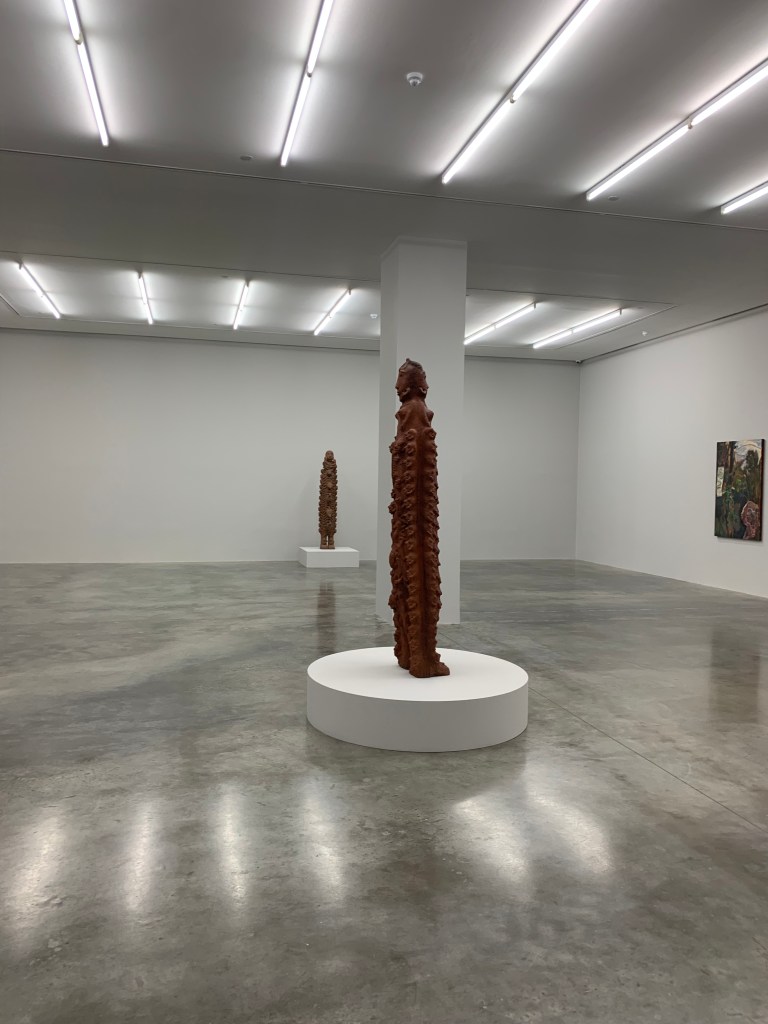
It is hard to decipher whether the white cube detracts from the social and political issues narrated within Armitage’s paintings and Camara’s mystical sculptures. The white cube is suggestive of the notion that the outside world must not come in, that it must not impose on the artworks but instead provide the environment for the artworks to speak for themselves. This setting however seems inappropriate for work so politically and geographically loaded, removing it from the world it is speaking of. Armitage’s use of lubogo fabric, and Camara’s use of Begnoni clay, locates the works to specific locations of the world. The viewer is left detached of this understanding of place, with the traditions of the white cube breaking this connection that seems so important in informing the work.
 Evie Banks