Suggested straight away in the title, The Rules of Art? exhibition at the National Museum Cardiff, works to question and re-evaluate the historical hierarchy of art that set the precedent for all art to have followed. Juxtaposition is used as a tool for reimagination, to start a new conversation and form new connections between artworks previously unconnected. The significance of the host for this exhibition is undeniable. In 1667 the French Academy created the hierarchy of genres, a ranking of importance of the different subjects portrayed within painting. This began with historical paintings depicting religious or historical moments categorised as most important, working down through portrait, scenes of everyday life, landscapes and finally still life, placed at the very bottom of the hierarchy. Institutions such as the National Museum Cardiff would have been guided by said hierarchy. Thus, a certain retrospective is commanded by the host, to challenge and reconsider the rules of art, to begin new conversations and form relationships between different artworks spanning centuries. The museum groups together artworks from its collection never shown together before, using juxtaposition in artists, materials, subject matter, size, and periods, to acknowledge shared connections to comment on contemporary social, economic, and political issues.
In the interest of simplicity, the exhibition is broken down into subsections, each room within the gallery space dedicated to a genre within the hierarchy. We begin with history, a room dedicated to biblical scenes, Greek and Roman mythology, and of historical events. It seems fitting to begin with history when considering its primary status within the hierarchy. Artworks have been carefully selected for the spectator to make direct comparisons. Helen Muspratt’s ‘Mother and Child, South Wales’ is placed directly alongside Allessandro Botticelli’s ‘Virgin and Child with a Pomegranate’. Despite the obvious visual difference of painting versus photography and the ornate versus the stripped back, also drawn to light is the social contrast of the holy and highly held versus poverty and unemployment. It would have been easy to place Muspratt’s photograph within the portraiture genre given the subject, however the dialogue and power that can be drawn against Botticelli cannot be matched elsewhere. The symbolism of the pomegranate, a Christian symbol of resurrection and thus hope and optimism, counter-parted by the honest faces of unemployed miners and their families, highlights the divides within societies spanning centuries. Curation uses Muspratt to draw on the visual language of religious art in which she exalts the lives of the working class to the same position in the hierarchy. The artworks become tools for the debate of politics versus religion.

You need only cross to the other side of the room to experience another direct comparison between artworks created over a century apart. Contemporary ceramic artist, Claire Curneen’s ‘In the Tradition of Smiling Angels’ is displayed in a way for the angels to overlook Maximillian Lenz’s ‘Spring’, in much a way that Christianity would tell us that angels watch over us, representing a larger presence. There are juxtapositions in Curneen’s sculpture alone. Inspiration is drawn from the religious motif, but not in the classical Greek sculpture depiction history has accustomed us to appreciate. The angels instead are moulded from terracotta, a commonplace and cheap material, paired with the use of gold carrying meaning of status and wealth. A look to the right and gold can also be found in Lenz’s grand painting, used by the artist in reference to an admiration to the symbolisms of Byzantine mosaics. Gold thus embodies the illumination of the universe by the divine light of God. Whereas Lenz pays tribute to the holy meaning of gold, Curneen uses the material to explore ideas of the ordinary existing alongside the extraordinary and thus calls into consideration the discarding of the hierarchical separation between not only art, but society.

Coexistence is a common theme throughout the exhibition. The small space off to the side of the room dedicated to history initially feels fitting for still life in relation to the historical hierarchy. Upon closer inspection however the viewer is confronted with a space busy with artworks to argue the genre’s importance and to break this traditional understanding. The genre of still life played a role in the changing perception of the rules of art, undermining the academy’s hierarchy. Paintings by artists such as Gwen John reinforce this break in the hierarchy, as one of the first generations of female artists in Britain allowed formal training. The inclusion of her paintings marks the shift of perspective and breakdown of the rules that would lead to the generally equal playing field concerning genre in contemporary art, and the shift into the conceptual. In reference to the conceptual and allegorical meaning is the inclusion of an example of Dutch flower painting. The importance of this painting is fleeting in comparison to the sub-genre of Dutch flower paintings in whole, which had a role in undermining the hierarchy and shifting perceptions. The short-lived blossoming of the cut flowers symbolic of life and the wilting blooms acting as a sharp reminder to the abruptness of life and grim finality of death. This painting acts as a subtle acknowledgement to the sub-genre’s role in the shift of perspective.
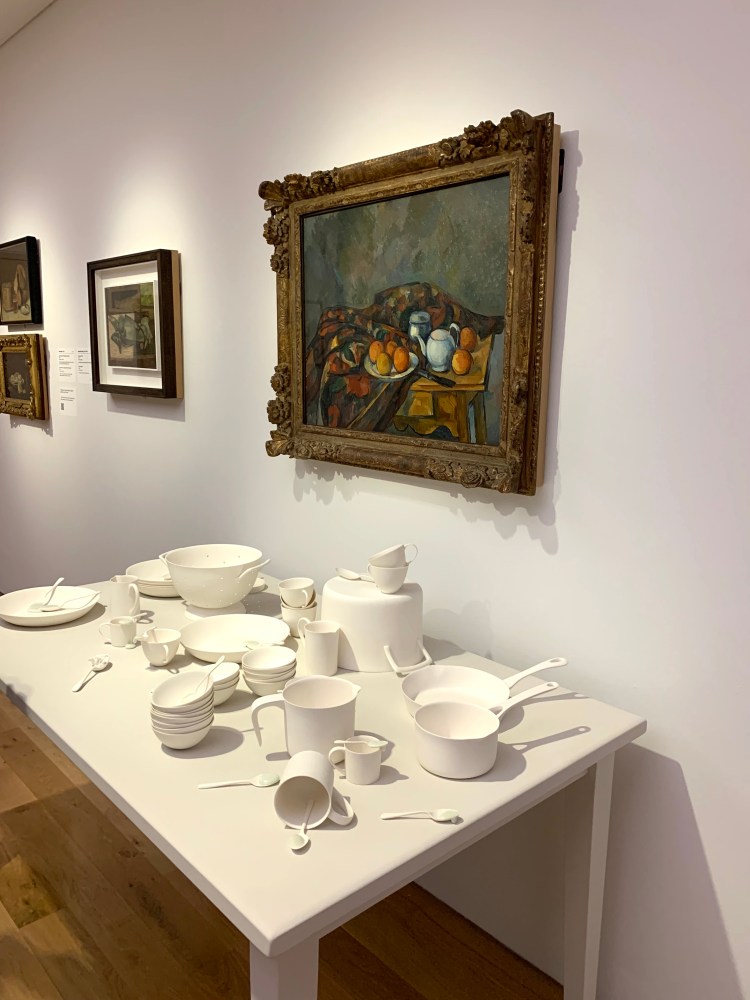
Particularly striking as you walk through the opening into the room is an installation of a contemporary still life arrangement, above which hangs a traditional still life painting by Paul Cézanne. The almost ghostly installation created by Zoe Preece, ‘An Archive of Longing (Material Presence)’ creates a space in between movements, capturing transitional moments and creating opportunity to open the conversation of existence. With reference to the shallow and decorative identity attributed to the genre in the traditional hierarchy, further supported by Cézanne’s ‘Still Life with Teapot’, curation draws the genre into a physical plane of existence to confront the viewer. Much like Claire Curneen’s use of material to oppose tradition, Preece fights the same cause but in a subtle opposite. The installation is made from porcelain, a material laced with connected narratives and historical attributes to status. Once again, the idea of the ordinary existing alongside the extraordinary is brought into play. The decision to leave the porcelain at its bare material, lacking any ornate decoration challenges traditions of still life, answering the question of how to dignify an ordinary life. The blank canvas so to say, leaves room for the viewer to write and reinvent the narrative. Within the exhibition, the genre of still life makes a powerful argument to its significance, helping the spectator to draw opinions surrounding the rules of art into question.
Historically a portrait was the object of wealth and status. Compare that to contemporary culture and the invention of smartphone photography, and the self-portrait has become nothing but ordinary. Paintings of everyday life give a snapshot into mundane daily experiences of “nameless” members of the lower-class society. The combination of both genres of portraits and the everyday, opens a conversation and debate surrounding the marked divide in the representation of society throughout history, and how this spotlight has shifted. This third room within the exhibition is built on direct confrontation. No better example can be seen than through the comparison of Joshua Reynolds’ ‘Major-General George Catchmaid Morgan’ with the photographic and sculptural work belonging to artist Donald Rodney. Joshua Reynolds was a major figure and contributor in the formation of art education in Britain, as the founding president of the Royal Academy. It was a sign of status to be painted by Reynolds, an overwhelming percentage of whom were white males and architects of the British Empire. This deepens the problematic legacy and entwined relationship with the histories of imperialism and transatlantic slavery. On the opposing wall sits Donald Rodney’s ‘In the House of my Father’, and ‘My Mother, My Father, My Sister, My Brother’. The grandeur of Reynolds is heavily contrasted by the intimacy of Rodney. A different kind of portrait is presented, one that explores identity through a critical microscope. Rodney’s skin house is made from his own skin, removed during treatment for sickle cell anaemia, a condition largely affecting individuals from African or Caribbean descent. The result is a rather gruesome and powerful self-portrait, carrying profound links to the idea of inherited experience. This is a powerful focus on mortality, a physical shrine appertaining memory of the slave trade, caused by individuals such as Major-General George Catchmaid Morgan. The curatorial choice to position the artworks on opposite walls offers both sides of perspective on what our modern-day society has been built on.
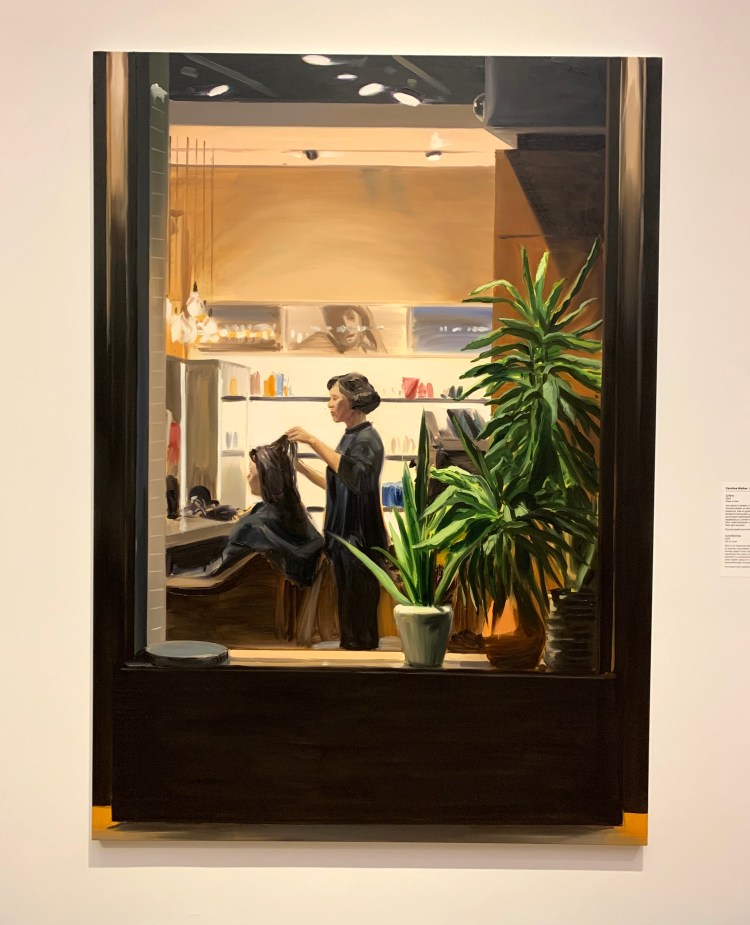
Reynolds’ glorification becomes the antagonist of the room through a multitude of comparisons. Caroline Walker’s ‘Conditioning’ focuses on the female, a largely undocumented sub-genre of historical portraiture, helping to bridge the gap between formality and unposed scenes of everyday life. Walker draws on the past to question present issues. By painting the unseen woman, her value is reinstated through the paint applied to canvas, giving the same spotlight to attack the hierarchical rules. Social, economic, and political issues are raised. Reynolds is placed in a position in which his subject overlooks Walker’s hairdressing scene, reinforcing the subversion of the notion of the male gaze. An overall feeling of protest back and forth can be attributed to this room. Much like in the room focused on history, the wealthy is juxtaposed by unemployment, deindustrialisation and social deprivation, topics still present and relevant in contemporary society.
The final room, much larger in size, with works more spaced out is devoted to the genre of landscape. Immediately upon entry there is a sensory overload of audio material, as artworks fight for command over the space. Visual stimulus comes across as subdued and modest when considering what the space has the capacity and potential to hold, maybe to make room for the audio protest. However, it seems a missed opportunity to have such a large and open space dedicated to the landscape, and to not bring the landscape within, especially considering the museum’s collection of David Nash sculptures. Instead, curation chooses to explore landscape through debates surrounding identity and place. Landscape was and remains an important genre for Wales and its artists. Inspiration of such can be seen in the video installation of Bedwyr Williams, ‘Tyrrau Mawr’. In an unrecognisable landscape, Williams the narrator tells the story of a dystopian future where an advanced urban city is built within a traditional Welsh landscape. Williams puts a satirical twist on mankind’s effect on the universe, exploring international issues with rapid urbanisation and the manmade smothering over the natural landscape. For those who had the chance to visit Artes Mundi in 2016, the same video installation could be seen but on a much grander scale where its commanding presence brought the viewer inside the narrative, creating an experience to be had. In this configuration, much of the visual command is lost, with the viewer taking an almost God-like position, spectating from afar. With great competition from John Akomfrah, Williams’ video installation takes second place in the exploration of social and economic issues surrounding landscape, designated the smaller screen.
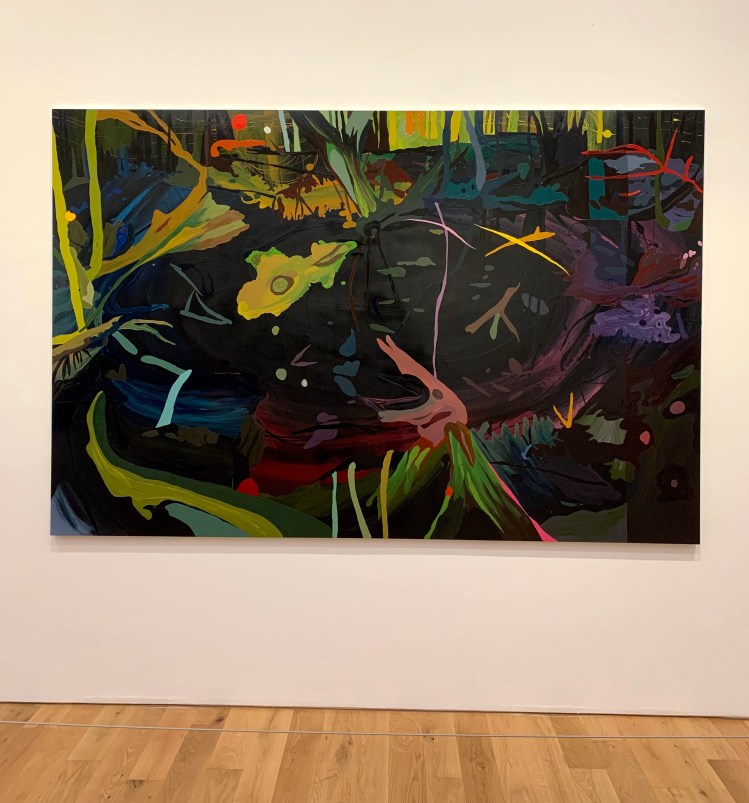
Following the wall along, the satirical perspective of man’s interaction with the landscape is identifiable in the work of Helen Sear. In this depiction, the genre of landscape loses its decorative quality, arguably the factor ranking it low within the hierarchy of art genres. Sear provides a reality check to romanticised ideologies of what landscape art should be. It is frustrating to look at, knowing that behind the hay bales is a view of Raglan Castle. Sear escapes the tourist postcard view, instead shedding light on a generally unrecognised object of agriculture reality. Considering this satirical standpoint, turning around in the gallery space 180 degrees shows paintings of Simon Ling and Clare Woods, whose work acts to reinforce the notion of the ornamental, aesthetic and decorative, with little ulterior motive. The spectator is once again confronted by juxtapositions, with quite literally one side of the room versus the other.
Trailing the near-distant sounds that echo throughout the room of landscapes, brings you to possibly the most stand-out acquisition featured in The Rules of Art? exhibition. John Akomfrah’s ‘Vertigo Sea’ draws together the hierarchies, asking us to consider the past in our wait for the future. Three screens showing natural history footage, performance by the artist, and archive film, combine to create an overwhelming experience designed to strike a nerve. The trio of films highlights the destruction brought along by mankind to the environment and to ourselves. Connotations of death are sinister. Starfish feasting on flesh, whilst slaves are mercilessly murdered, and predators catch their prey. The word vertigo is associated with a whirling loss of balance. Akomfrah calls to attention the notion of the sublime, the feeling of awe we experience to the beauty of the natural world (in this case the ocean), whilst confronting us with terror to the manmade realities. The ocean in this instance is as much the antagonist as it is the protagonist. In a beautiful final touch, paired with the sheer magnitude of the installation is a modest painting by one of the most notable landscape painters of the 19th century, JMW Turner. In a full loop around, there is masquerading once more by history to the honest consequences presented by the contemporary, as a notion back to the hierarchical position of romanticised landscapes.

The Rules of Art? is an eye-opening, thought-provoking exhibition, taking a completely new perspective on how artworks are curated and shown together, to offer new interpretations to that displayed. Whilst history has been explored, the institution provides no definitive answer, thus opening the debates of the rules to the public. Even more interestingly, the museum has decided to collaborate on this exhibition with young, less experienced individuals within the arts sector, offering opportunity to co-curate the large-scale exhibition. The payoffs of which will result in a switch-around in the space currently playing host to John Akomfrah’s ‘Vertigo Sea’. The hierarchy has thus been dismantled one step further, leaving a whole new interpretation to be channelled by an external perspective, breaking down the third wall of curation within the institution.
Evie Banks, 6 July 2022.
 Evie Banks