Commissioned text for New Contemporaries 2023 exhibition.
READ ON NEW CONTEMPORARIES PLATFORM.
Theorist Bill Mollison, who developed the idea of permaculture, speaks to a need for embodied immersion in the earth’s ecological cycles that requires an extended period of observation before acting on the land and its processes. Parallels can be drawn to the paintings of Georg Wilson, whose mythical and enchanting surfaces are directed by the cyclical changes of the English seasons. Wilson’s work tells the story of the landscape from equinox to equinox, using fluid brushstrokes to reflect a porous landscape where experiences and temporalities overlap, intertwine and coexist. Wilson’s paintings are found in a temporality between English folklore, history, landscape and custom. Mythical creatures, animals and the landscape come together in symbiotic relationships to create enchanting compositions that evoke a sense of curiosity and exploration. Subtle in approach, Wilson’s practice encourages a reconnection with the natural world in all its forms through enchanting iconography and thick, swirling, earthy tones.

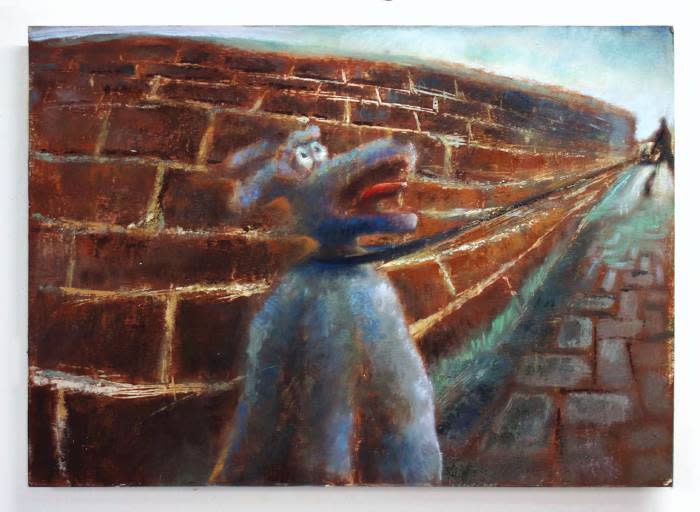
Like Wilson, Ranny Macdonald’s work has mythical qualities, but whereas Wilson depicts coming together and living harmoniously, Macdonald’s work explores strained relationships between humans and nonhumans, placed in ethereal dreamscapes. His process weaves together everyday experiences with threads of visual culture combining art historical references and popular culture. The more-than-human participants Macdonald choses to portray are those we have domesticated, our pets, mainly dogs and cats. Although the muted palette and blurred borders suggest a dreamworld, it is only upon close inspection that the mood of the work shifts towards the nightmarish. In the work You Just Call Out My Name (II) (2023), a cartoonish dog is being led, or rather choked by its collar along a bricked-up street. What initially seems a humorous scene also displays a sombreness that underlies the work, for which you can’t help but feel a twinge of guilt. Macdonald calls into question our relationships to nonhumans with a particular focus on care, or in this case the lack thereof. This lack extends further into the surroundings areas, where the bricked-up walls and floor highlight an environment far from nature – an attempt to show how we have also domesticated nature, producing synthetic landscapes. Macdonald’s work speaks to domestication at its very root, and whilst humanity has profited from domestication, Macdonald shows the other side of the coin.
Notions of synthetic landscapes can also be seen in Helen Clarke’s large-scale installation Propagation (2020). Clarke’s work weaves together themes of extractivism, modern production and consumption to interrogate the complexities of contemporary relationships with the natural world, mostly the nature/culture dichotomy. In Clarke’s work, this idea leads to a suggestion of a move towards ecological care. Clarke addresses ideas of consumption through the use of PET containers, a plastic most commonly used for single-use drink bottles destined for landfill. By taking domestic items out of their everyday contexts and repurposing them, she reinvents functionality and asks us to reconsider what we could dispose of. The phrase ‘reduce, reuse, recycle’, comes to mind in finding new meaning in a largely throw-away culture.

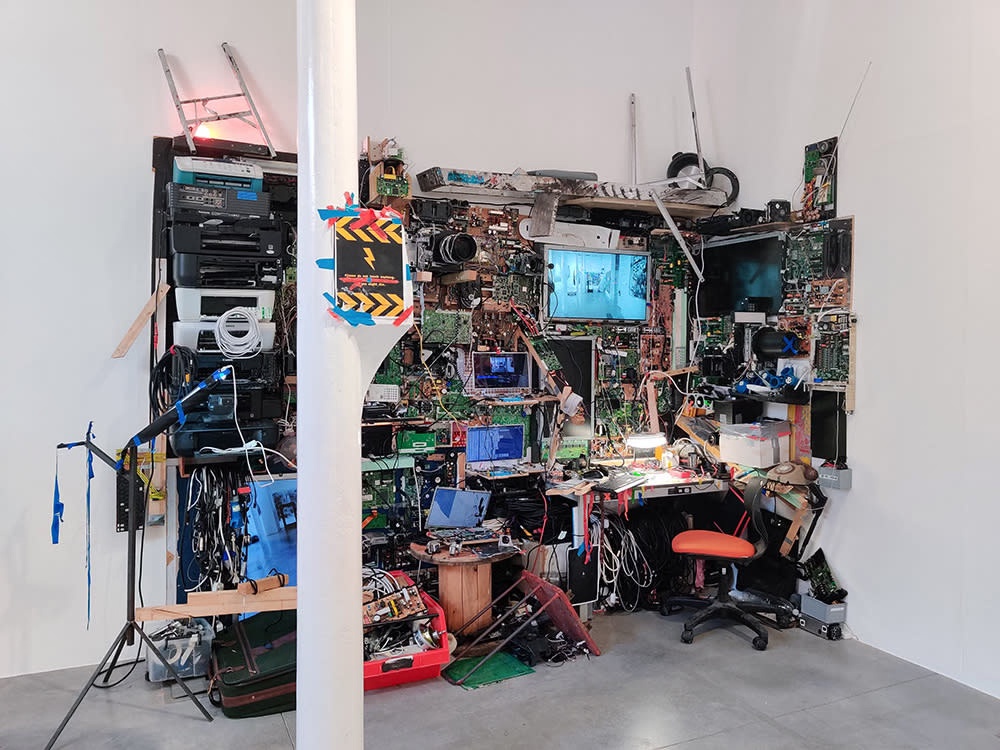
It would be difficult to discuss the environment without discussing the technologies that act as a causal factor in the human/nature dichotomy. Consumer culture and its excess of waste is also referenced in Zayd Menk’s installation 4.3.2‽</>_-⨅⨼ (2022), whose title is reminiscent of computer code, and whose construction echoes a post-consumerism landscape of discarded technology. At the core of Menk’s practice is an inquiry into our complex relationships with technological progress and consumerism, and the ecological implications of technological developments. Using electronic waste as his primary material, Menk creates structures that consider the possibilities and limitations of our agency in a world increasingly dominated by machines. Again, our relationship to the world around us is questioned, in this instance presenting a view of how humanity has become subservient to technology as an omnipresent force that has taken over. Menk’s installation is made of old and discarded technology, including computers, hard drives and cables, otherwise destined for landfill. As the latest technological developments draw our attention since they are these new shiny toys, little thought is given to where our old technology ends up or the environmental impact of its disposal. Menk refocuses our attention to the discarded, creating a space for self-reflection in a consumption-driven society.
In the discussion of environmental concerns, artists have a responsibility of care; to create artworks that change people’s behaviour and perception and to encourage contemplation, reflection and reconnection. All four artists discussed in this essay make proposals that address the possibility of change by visualising important ideas that relate to the environmental discussion. Notions of care and our relationships to the world are focal points in their works, as Wilson and Macdonald, for example consider our relationships to the more-than-human. Whilst Wilson works with the seasons as a mode of relational involvement that requires ecological care, Macdonald addresses our relationships to the nonhuman, questioning our anthropocentric tendencies as a way to encourage an intertwining of human and nonhuman worlds. Clarke and Menk, on the other hand, consider our relation to the world in the context of consumer culture by creating human-made ‘landscapes’. In their works, both artists confront our damaging actions and encourage responsibility.
 Evie Banks